
Conference and video setup
Background
It started during the pandemic, like so much else. Video calls all day – work meetings, evenings hanging out with friends in virtual rooms, months of it. At some point I noticed I was unconsciously judging people by the quality of their audio and video. Someone joining a call with a bad microphone and a grainy webcam image seemed less competent – unfair, but apparently how my brain works. Then I turned the question around: how do I actually sound and look to others? The answer was not satisfying enough. Time was available, tinkering was on the agenda anyway, and so the setup grew – and then escalated a little.
Realisation
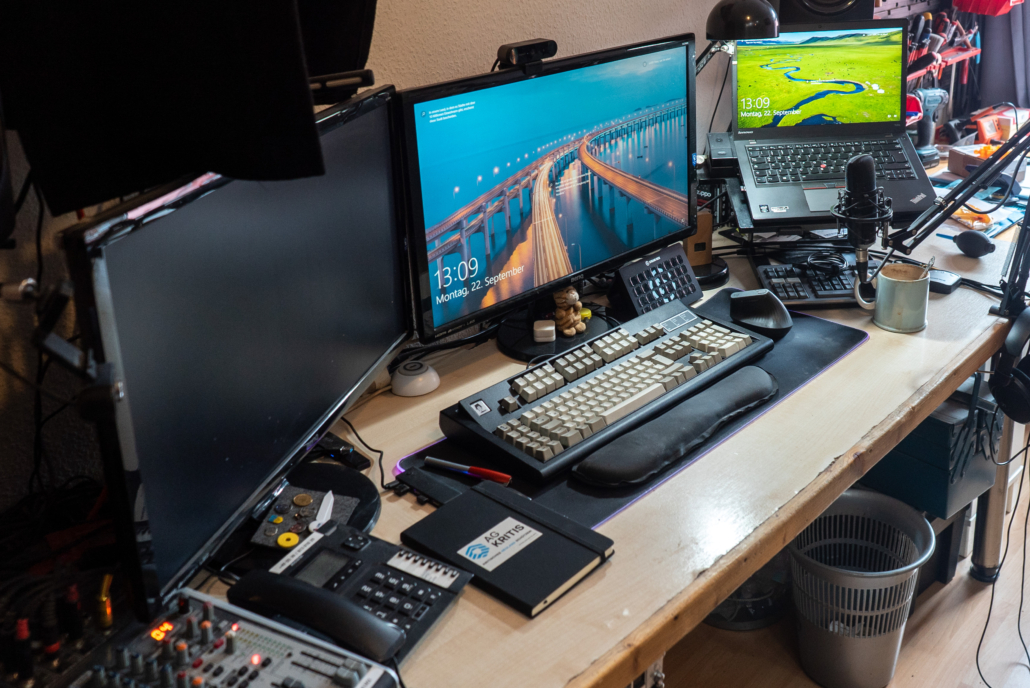
The centrepiece is a Behringer Xenyx 1602, a 16-channel analogue mixing desk. It is the central hub for everything that produces or receives audio. Mixing desks like this are common in recording studios and on stage – here it manages multiple microphones, the laptop and other sources simultaneously, shaping the sound before it reaches the computer.
My main microphone is a t.bone SC-400, a condenser microphone on a desk lamp-style boom arm. It passes through a Behringer Composer Pro-XL, a device that catches volume peaks and lifts quieter passages, keeping my voice even and clean. A cheap Behringer lavalier mic – the small clip-on type familiar from TV interviews – also runs through the Composer Pro-XL on channel 2. It comes into its own during TV live broadcasts, paired with the teleprompter. A directional Audio-Technica AT875R is available as a further option, a microphone that only picks up what is directly in front of it. I use it rarely: the SC-400 simply sounds too good.
All microphones and inputs sum internally to a shared bus, subgroup 1-2 in mixing desk terminology. From there the signal goes into a Behringer HA400, originally a headphone amplifier with four outputs, which I repurpose as a signal splitter. It distributes the summed signal three ways simultaneously: to a KVM switch with its own USB soundcard (giving my work laptop the mixer’s audio via USB-C), to a USB-C output for my smartphone as a full duplex audio interface, and to the desktop computer. The master output of the mixer feeds a pair of JBL 3-Series MkII studio monitors, my main speakers.
For video calls and talks I run OBS on the desktop. OBS is free software originally built for live streaming, but it works excellently as a virtual video mixer – I can combine camera feeds, screen content and other sources and feed the result into video calls as a virtual camera. The main camera is a Logitech Brio 4K. An old 720p USB webcam serves as a room camera – more of a curiosity than a serious component. An Elgato Stream Deck XL, a control surface with 32 programmable keys each with a small display, handles OBS and other functions. A DaVinci Speed Editor sits on the desk for video editing, a dedicated hardware controller for DaVinci Resolve.
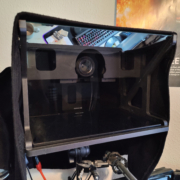
The third camera lives inside the home-built teleprompter. A teleprompter displays text on a monitor that is reflected via a half-silvered glass placed in front of the camera – the camera shoots through the glass while the speaker reads the reflection and appears to look directly into the lens. For me this is primarily the tool for TV live broadcasts: I read the script off the glass, look straight into the camera as far as the viewer is concerned, and have the lavalier mic clipped to my lapel. It works cleanly because image and audio run completely separately from the rest of the setup and feed into OBS without any fuss.
The most unusual piece is a Comrex DH30, a professional device that transmits audio over telephone lines. I use it via DECT – the cordless home phone system – routing the audio of a running video call to a cordless handset. If I need to step into the kitchen mid-call, I just keep listening.
Audio cable plan
To increase visibility and to have a clean overview, I decided at some point to draw a plan of all the audio connections.
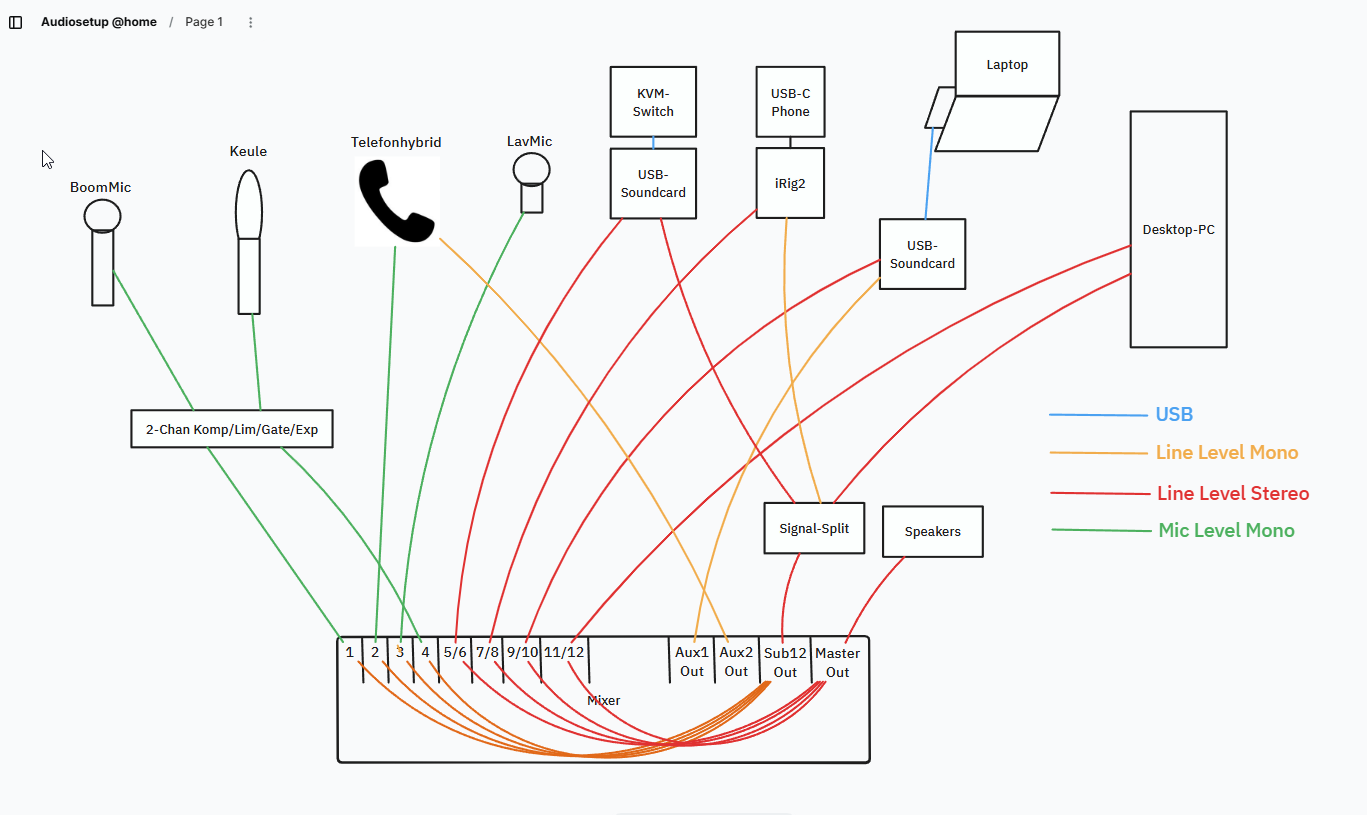
Verkabelung Audio
New hardware, old problems
In October 2025 a new computer joined the setup. The onboard soundcard – the audio chip integrated into the motherboard – turned out to be a problem: an undocumented auto-gain, an automatic volume control, that became completely confused by the low noise floor of my system, producing audio that was simply unusable. The fix was an ESI Maya44, an external soundcard in the form of a small expansion card. Stable ever since.
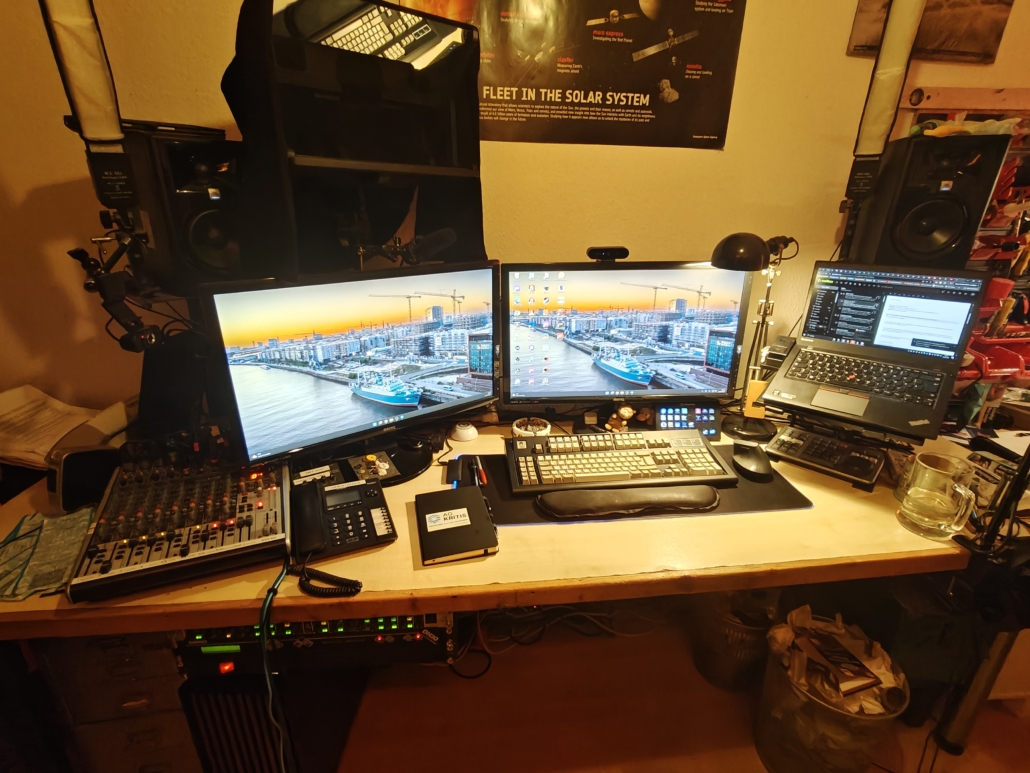
Result
The core setup has not changed since 2021. Small adjustments in 2022 and 2023, the new computer in 2025. What works gets left alone.