
CNC engraving machine recommissioned
Background
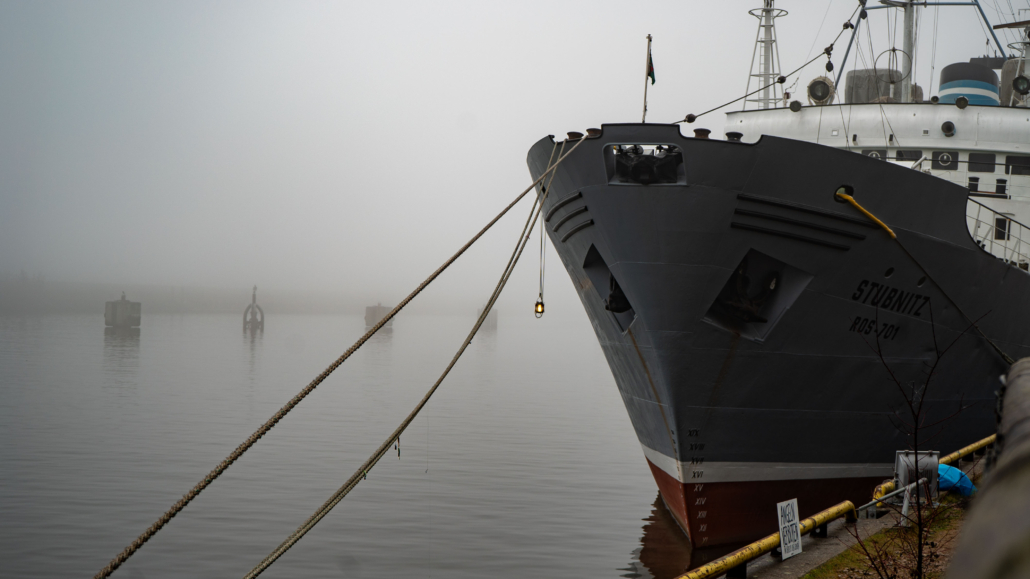
The MS Stubnitz is a former East German fishing and refrigerated cargo ship, now a floating cultural centre in Hamburg. The ship has an ongoing need for period-accurate signage – cabin plates, warning signs, labels – engraved on two-layer plastic, not printed. A CNC engraving machine was available on board for exactly this purpose, but nobody had operated it for about five years. The crew member responsible had left without leaving anything behind: no documentation, no software, no computer. The crew asked me to get it running again. On 7 June, hrmny and I travelled to Hamburg. Both of us worked remotely during the day for our employers, so all work on the machine happened in the evenings and at night.
Assessment and repair
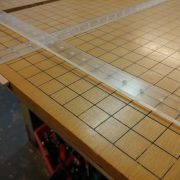
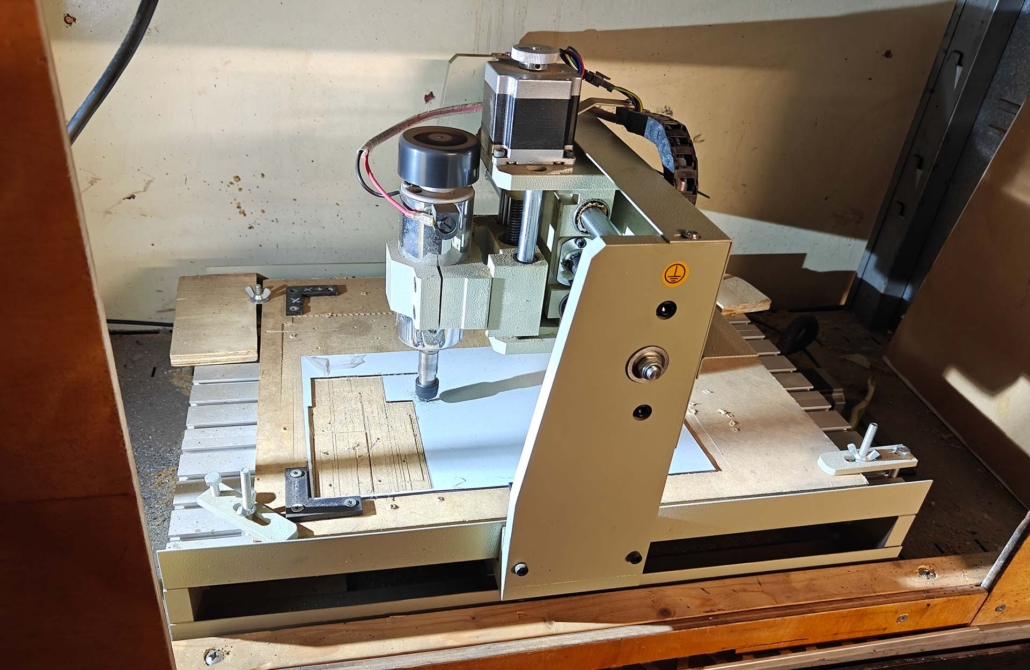
The machine is of unknown origin, with no manufacturer markings or type plate. It runs an Arduino with GRBL firmware, with an ER11 collet spindle for 3.175 mm shank cutters.
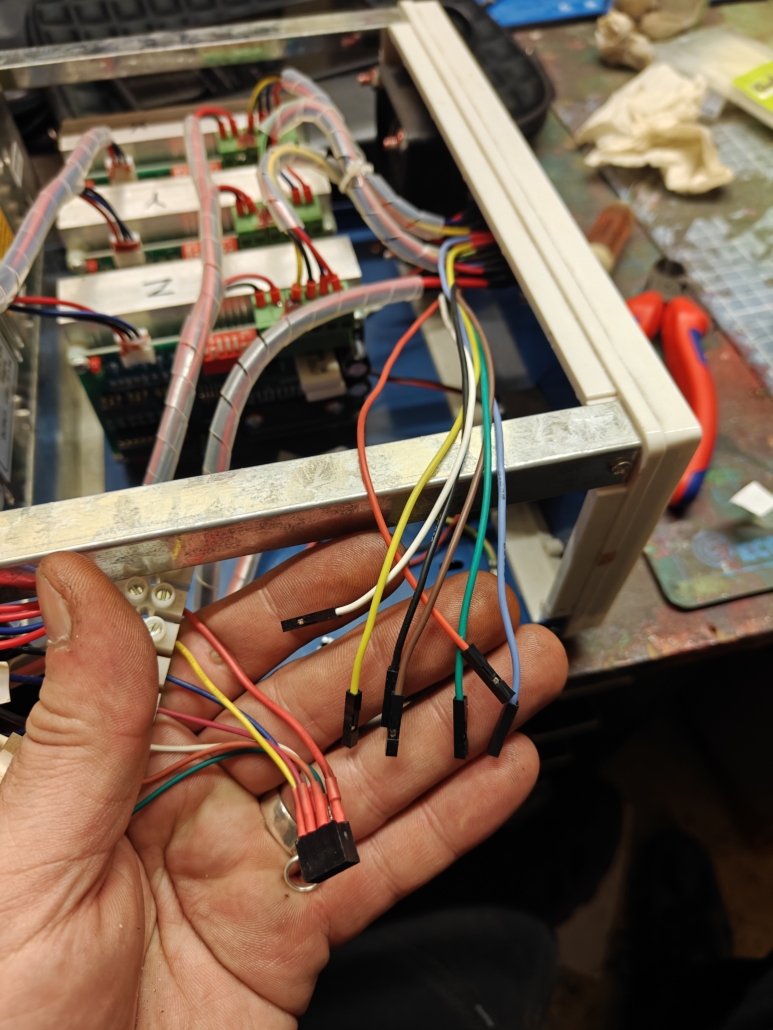
Sunday went on assessment, tidying up, and first attempts to get the machine running. When we powered it up, nothing moved. The cause was straightforward: the enable pin on the stepper motor drivers was not connected. While trying to reconnect it, a second cable broke off. We replaced the entire dual-row pin header connecting the stepper drivers to the motion controller. By Monday the machine was making its first movements.
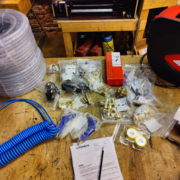
The machine had no limit switches. On Tuesday and Wednesday we fitted mechanical limit switches to all axes – two each on X and Y, one at the upper end of Z – and ran new wiring throughout. We also pulled additional conductors into the cable harness to prepare for a future touchplate for tool length measurement.
Obstacles
Wednesday night it became clear that the Z limit switch was not responding. We initially assumed a hardware fault on the Arduino and put the word out through the Hamburg hacker community. Someone brought us a replacement Arduino on Thursday afternoon. It showed identical behaviour with the same firmware – ruling out a hardware defect.
The actual problem was a GRBL configuration that assumed a spindle with variable speed control. In that configuration, a pin is assigned as PWM output for spindle speed and is therefore no longer available as an input for the Z limit switch. With some AI assistance we found the relevant line in the firmware configuration, commented it out, reflashed, and the Z limit switch worked.
Font and templates
About a year before this visit I had photographed many of the original signs on board and put together a small typographic study, intending to reconstruct the font used. That turned out to be unnecessary: a font already existed on board, developed by artists specifically for the ship.
The original signs were made with a pantograph, using a TGL typeface from the GDR as the template. The pantograph rounds off angular letterforms through the diameter of the stylus and cutter, so the result no longer looks like the TGL original but has characteristic rounded strokes. There is also a tendency for the cutter to dwell slightly at the start of each new letter, producing a marginally deeper entry circle – visible on some of the original signs. The new font accounts for both: it carries the rounded strokes and deliberately places a slightly enlarged circle at each letter’s entry point. The result is not a copy of the TGL typeface but a reconstruction of what the pantograph actually produced.
Result
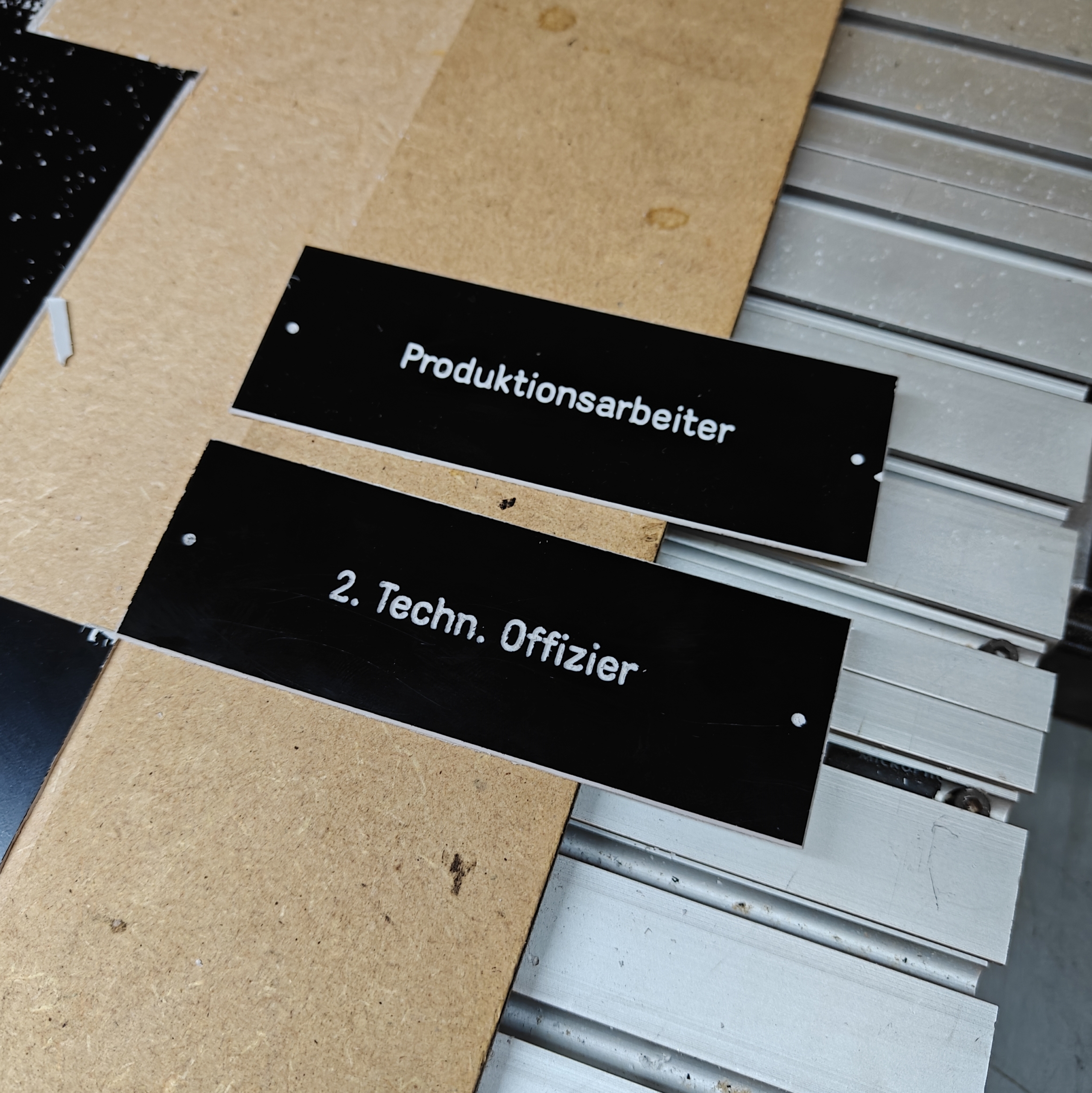
On Friday evening we produced signs from a list the crew had prepared in advance – missing and damaged signs from throughout the ship, including a run of 32 signs showing which way to turn the ventilation handle in each cabin. Afterwards we wrote an operating manual covering the complete workflow from Inkscape to finished sign. Two crew members have been trained and should be able to operate the machine independently.
The touchplate is still missing. The wiring is prepared; it just needs to be sourced and connected.